
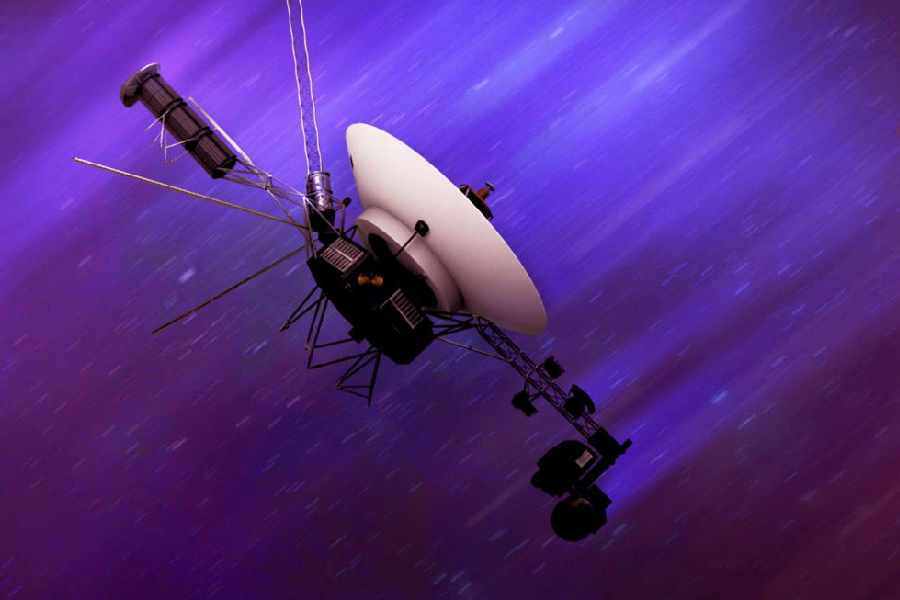
NASA's Voyager 1 spacecraft is set to achieve a significant milestone on Wednesday, reaching a distance of one light-day from Earth. Traveling at approximately 38,000 miles per hour (61,000 kph) through interstellar space, the probe will hit this mark—equivalent to roughly 16 billion miles (26 billion km)—at 5:16 a.m. ET (1016 GMT). Launched in 1977, Voyager 1 remains the most distant human-made object in existence.
Alan Cummings, a senior research scientist at Caltech’s Space Radiation Laboratory and a member of the Voyager program since 1973, described the achievement as a testament to both the probe's longevity and the agency's ability to maintain communication over such vast distances. "I view it as an engineering milestone, marking the amazing longevity of Voyager 1 — and also an engineering achievement to be able to communicate with Voyager 1 at its distance," Cummings said.
Voyager 1 and its twin, Voyager 2, were launched 49 years ago to explore the outer solar system. Voyager 1 departed Cape Canaveral, Florida, on September 5, 1977, aboard a Titan IIIE-Centaur rocket. During its primary mission, the spacecraft provided critical data on Jupiter and Saturn, including the discovery of a thin ring around Jupiter, two Jovian moons, five Saturnian moons, and Saturn's G-ring. Voyager 2, which followed a different trajectory to visit Uranus and Neptune, is expected to reach the one light-day milestone in November 2035.
Since exiting the heliosphere—the sun's protective bubble of magnetic fields and particles—in 2012, Voyager 1 has continued to transmit data from interstellar space. Cummings noted the scientific significance of this data, particularly regarding galactic cosmic rays. "It was the first spacecraft to report the energy spectra of galactic cosmic rays (fast-moving energetic particles) at low energies. Those energetic particles are not observable inside the heliosphere because of the push-back by the solar wind. This was the holy grail of low-energy cosmic ray physics," he explained.
Cummings, now 82, joined the project at age 29 after a failed balloon experiment for his doctoral thesis led him to the Voyager team. Reflecting on his 53-year tenure, he remarked, "The loss of the balloon was lucky for me as the Voyager mission has been the backbone of my career."
Both spacecraft carry a Golden Record, a 12-inch gold-plated copper disk containing sounds, images, and greetings in 55 languages intended to represent Earth to potential extraterrestrial life. While some have expressed concern that the record provides directions to Earth, Cummings remains unconcerned. "I've heard that concern a little over the years but I never worried about it. It's pretty unlikely the aliens will find it," he said.