
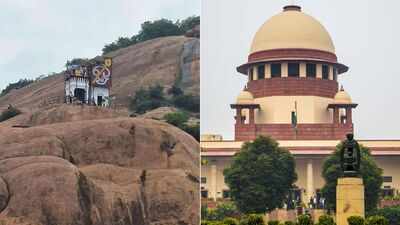
Why has the lighting of a single lamp at Thiruparankundram in Madurai become such a major controversy?
Why are Hindu organisations demanding permission to light the lamp at a particular location? Why are Muslim representatives raising objections? Why has the Tamil Nadu government approached the Supreme Court?
And most importantly, what has the Supreme Court actually decided?
Let's understand the entire controversy in simple terms.
First, what is special about Thiruparankundram?
Thiruparankundram, located near Madurai in Tamil Nadu, is one of the most important religious sites for Hindus.
It is home to the famous Thiruparankundram Murugan Temple, considered the first among Lord Murugan's six sacred abodes, known as the Arupadai Veedu.
But the hill is not associated with Hindu worship alone.
The Sikandar Badusha Dargah, an important Muslim religious shrine, is also located near the summit.
The hill also contains ancient Jain heritage sites.
For generations, different communities have maintained religious and historical connections with this hill.
So how did this location become the centre of a controversy?
What exactly is the dispute?
Every year, the Karthigai Deepam festival is celebrated at Thiruparankundram.
As part of the established festival practice, a ceremonial lamp is lit near the Uchi Pillaiyar Temple on the hill.
However, some Hindu devotees and organisations have been demanding that an additional lamp be lit at a stone pillar located higher up the hill, near the Sikandar Badusha Dargah.
They claim that this stone pillar is an ancient Deepathoon, traditionally used for lighting a ceremonial lamp.
But the Tamil Nadu government has questioned that interpretation.
According to the government's position, there is insufficient evidence to establish that the pillar was traditionally used for Karthigai Deepam.
The government has argued that it may instead be an old survey marker.
This difference of interpretation has become one of the central issues in the dispute.
Why are Muslim representatives objecting?
The Sikandar Badusha Dargah is situated near the disputed location.
Representatives of the dargah maintain that the Muslim community has historically recognised rights over certain portions of the hill, particularly around the shrine and its access routes.
They are concerned that permitting a new religious practice at the disputed location could affect those existing rights.