
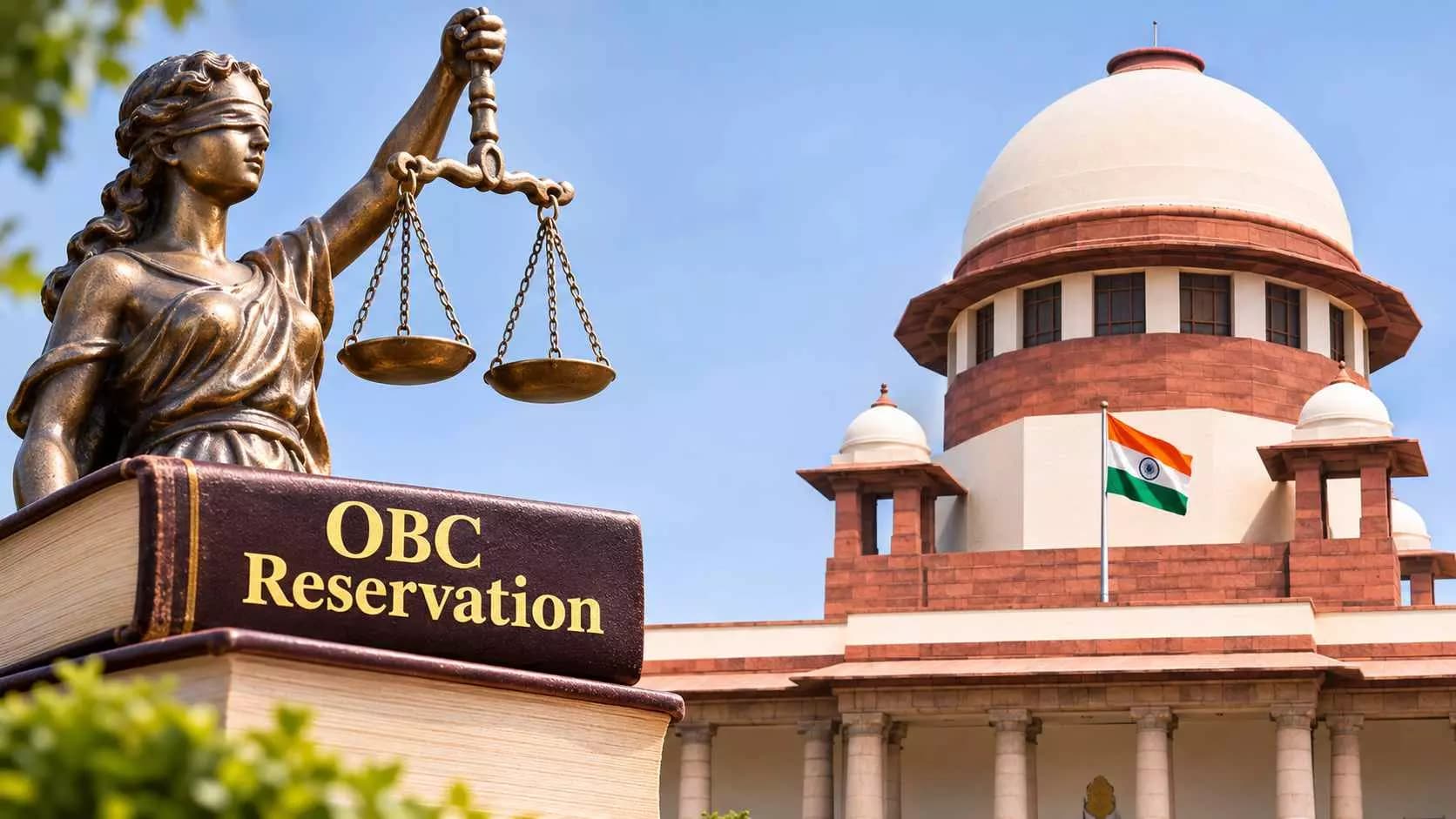
The Supreme Court issued a significant clarification on Friday, November 6, regarding the implementation of its March 11, 2026, judgment on Other Backward Classes (OBC) reservation. Justices P.S. Narasimha and R. Mahadevan ruled that while completed appointments remain protected from being reopened, the court’s refined interpretation of the 'creamy-layer' principle must be applied to service allocations for candidates from the 2025 Civil Services Examination.
The core of the legal dispute, addressed in Union of India v. Rohith Nathan, centers on how the government determines creamy-layer status. The 1993 Office Memorandum, established following the Indra Sawhney judgment, was intended to exclude socially and educationally advanced individuals from reservation benefits. However, the court found that the government had inconsistently applied these criteria, often penalizing children of employees in public sector undertakings (PSUs), banks, and private companies by using parental salary as a sole determinant, while failing to account for the actual rank and status of the positions held.
In its March ruling, the Supreme Court held that parental salary cannot be the exclusive factor for determining creamy-layer status. The court emphasized that the government must consider the equivalence of posts held by parents in the private or public sector against comparable government roles. The recent order clarifies that this legal standard is binding under Article 141 of the Constitution and must guide all pending and future recruitment processes.
Regarding the 2025 Civil Services Examination, the court rejected the Centre's request to apply the old criteria. Although the UPSC declared final results on March 6, 2026—five days before the original judgment—the court noted that the service allocation process remained pending. Consequently, the government is now required to apply the clarified creamy-layer principles to these allocations.
The court categorized the impact of its ruling into three groups. First, successful litigants and intervenors in the current proceedings are entitled to relief, with the court permitting the creation of supernumerary posts to accommodate them without disrupting existing seniority. Second, candidates with pending claims in various tribunals or courts will have their cases examined individually on their merits. Third, the court explicitly barred any general reopening of recruitment procedures that were finalized before March 11, 2026.
While the Centre had requested two years to complete an 'equivalence exercise' to align its policies with the court's interpretation, the bench declined to set a specific timeline. Instead, it directed the executive to consult stakeholders and frame policies that conform to constitutional principles. Additionally, the court granted a two-month extension for successful litigants to comply with its directions.